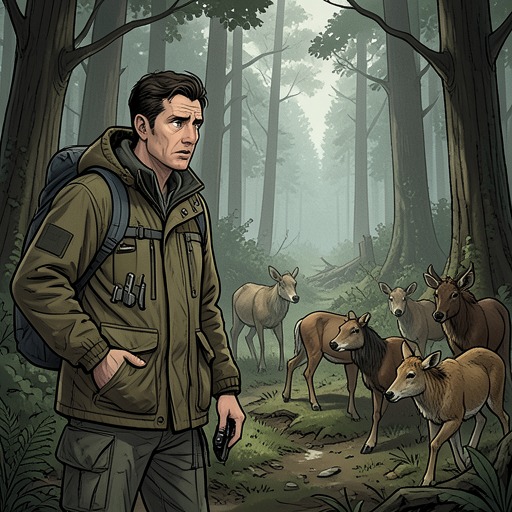
Zoomorphism
Life of PiZoomorphism names the animal-side counterpart to anthropomorphism: an animal takes a human being or another species to be one of its own kind. The concept gathers the book’s unexpected cross-species relationships under a single idea, but its examples are not merely curiosities. They suggest that an animal’s social world can depend less on strict species boundaries than on companionship, familiarity, and a workable place within a group.
Definition and behavioral setting
The distinction is one of perspective. Anthropomorphism attributes human qualities to animals; zoomorphism describes an animal assimilating a human or another animal into its own social category. The book introduces this idea in a discussion of surprising living arrangements, treating them as instances of an animal equivalent of anthropomorphism rather than as proof that species differences have disappeared.
That distinction matters in the surrounding account of zookeeping. Animals respond to perceived threats at different distances and through different senses: cats look, deer listen, and bears smell. A flamingo may tolerate a person at more than three hundred yards, while a giraffe may allow a closer approach from a motor car than from a person on foot. Keepers try to reduce such flight distances through knowledge, food, shelter, and protection. Pi’s father is described as an intuitive keeper who watches animals closely and guesses what is on their minds. This management can make animals more settled around humans, but it is not itself zoomorphism: acclimation changes an animal’s response to people, whereas zoomorphism describes an animal treating another being as a member of its own kind.
Companionship across species
Several examples make companionship the clearest force behind such cross-species arrangements. A golden agouti and a spotted paca lived contentedly together, huddling and sleeping against one another until the golden agouti was stolen. The account places this pair alongside the herd of Indian rhinoceroses and Goats at the Pondicherry Zoo. In each case, the notable fact is not simply that different species occupy the same space, but that they form an arrangement recognizable as social closeness.
Dolphins that help drowning sailors are another example: they push people toward the surface and hold them there, behavior the book compares with the way dolphins help one another. The comparison makes human rescue legible as an extension of animal social behavior, without claiming that the dolphins understand the sailors’ identity as humans. A reported stoat-and-rat companion relationship sharpens the contrast: the stoat lived alongside one rat while consuming other rats presented to it. Familiarity, in this account, appears to matter more than a general change in the predator’s nature.
Dogs caring for Lion cubs offer a related but distinct form of inclusion. The cubs eventually grow larger and more dangerous than their caregiver, yet they do not trouble her, and she retains her placid behavior and authority over the litter. The public may mistake the dog for food left for the Lions, so signs explain the arrangement. The same need for explanation arises at the Pondicherry Zoo, where a sign clarifies that Indian rhinoceroses are herbivores and do not eat Goats. These notices expose the gap between what visitors assume from species categories and what the animals’ actual relationships show.
The viper enclosure and the return to ordinary behavior
The mouse that lived among vipers is the book’s most carefully traced exception. While other mice placed in the terrarium disappeared within two days, this one survived for weeks. It built a nest, stored grains in separate hiding places, and moved openly among the snakes. The zoo put up a sign to draw visitors’ attention to the unusual coexistence.
The arrangement ended when a young viper killed the mouse; an adult viper then consumed it. The narrator wonders whether the young viper failed to recognize the mouse’s special status, or whether it had not become socialized to the unusual arrangement. The explanation remains uncertain. What is clear is the consequence: once the exception ended, the other mice again disappeared at the usual rate. The episode presents zoomorphism as a fragile social condition, not a permanent suspension of animal behavior. An individual relationship can interrupt an expected pattern, but that pattern may reassert itself when the relationship breaks.
Rank, training, and the limits of the concept
The discussion of circus Lions further connects cross-species recognition with social order. A human trainer can be treated as the dominant figure in the ring; the performance depends on maintaining that position. The book’s account of animal rank emphasizes that uncertainty about social standing can make an animal nervous and dangerous, while an encounter may establish rank without a fight. The trainer’s ascendancy is presented as psychological, built through posture, composure, gaze, movement, and signals. In this example, the Lions’ apparent acceptance of a human leader is a socially useful fiction: it helps preserve order and keeps the animals occupied and fed. The arrangement is therefore not just an amusing misidentification; it has consequences for the group’s stability.
The distinction also clarifies the later account of Richard Parker. When the Bengal tiger makes a quiet prusten call, Pi recognizes it as a sign of friendliness and harmless intentions. He interprets the sound as meaningful, and the shared danger of the lifeboat becomes the basis for his resolve to train the tiger. The passage describes Pi’s reading of animal behavior and his effort to establish a workable relationship; it does not say that Richard Parker takes Pi to be a tiger or otherwise identifies him as one of his own kind. That limit keeps the concept precise: closeness, communication, and dependence between species may accompany zoomorphism without constituting it.
The zoo as a human institution
The Pondicherry Zoo’s animal relationships exist alongside a more administrative view of animal life. When the zoo is sold, animals are assigned to buyers, and their movement requires negotiations, health and origin certificates, permits, quarantine arrangements, and transport. The Convention on International Trade in Endangered Species (CITES) has just come into effect, and the book describes zoos as increasingly dependent on transfers between institutions. Some animals attract strong demand; others are considered too common, while one prospective buyer conditions acceptance of a hippopotamus on an eye operation. American inspectors examine the animals before approving their papers.
This trade does not explain zoomorphism, but it gives the concept a revealing institutional contrast. Animals may be priced, inspected, and moved as part of a collection, yet the relationships described in the zoo resist reduction to inventory: a stolen companion changes an established pair, a dog’s authority over growing Lion cubs persists, and one mouse’s unusual place among vipers alters the enclosure’s ordinary pattern for a time. Zoomorphism names that social dimension of animal life, where the boundaries imposed by classification and commerce do not fully determine who can live alongside whom.